Microwave Imaging using Neural Operators
Introduction
Microwave imaging (MWI) uses electromagnetic waves to probe the interior of a medium via its scattered fields. Classical numerical solvers such as the Finite Difference Time Domain (FDTD), Finite Difference Frequency Domain (FDFD), and Method of Moments (MoM) provide accurate solutions to Maxwell’s equations, but are often too slow for large-scale or near real-time applications.
In this project, I approximate the forward scattering operator using a Convolutional Neural Operator (CNO). Once trained, the CNO serves as a fast surrogate that maps material permittivity and incident fields to total (or scattered) fields much faster than traditional solvers.
Forward Problem Definition
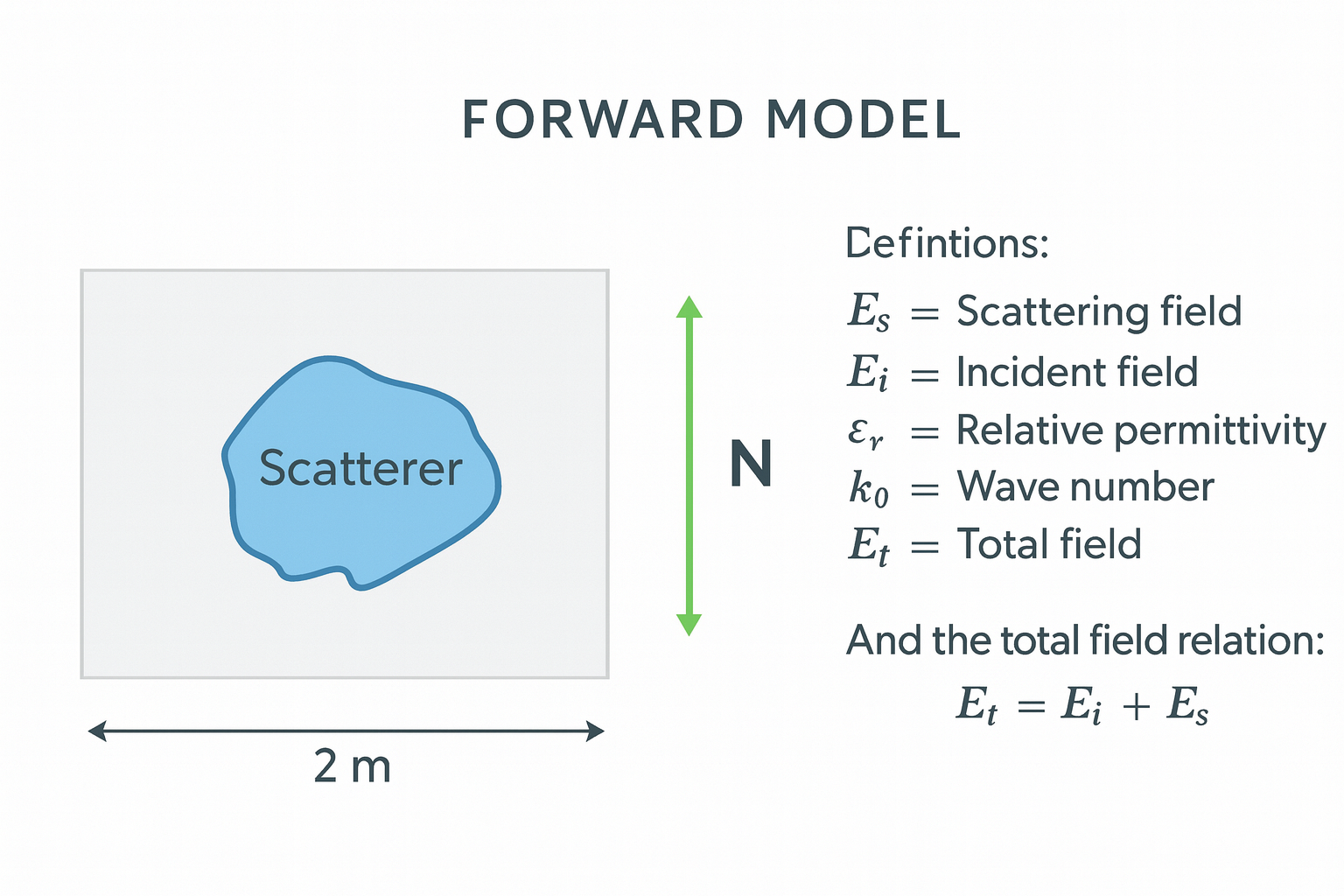
The goal is to learn a mapping from spatially varying relative permittivity $\varepsilon_r(x,y)$ and a given incident field $E_i(x,y)$ to the resulting total field $E_t(x,y)$:
$$ (E_i, \varepsilon_r) \;\longrightarrow\; E_t, \qquad E_t = E_i + E_s. $$
All fields are complex-valued:
$$ E(x,y) = \operatorname{Re}(E) + j\,\operatorname{Im}(E). $$
Helmholtz Equation for 2D TM Mode
For a 2D transverse magnetic (TM) formulation with non-zero $E_z(x,y)$ and invariance along the $z$-axis, the scalar Helmholtz equation is
$$ \nabla^2 E_z(x,y) + k^2(x,y)\,E_z(x,y) = 0, $$
where $$ k^2(x,y) = \omega^2 \mu_0 \varepsilon(x,y). $$
Simulation Setup
The training dataset is generated using a numerical solver (FDFD / related frequency-domain scheme) on a fixed 2D domain. The key parameters match the configuration used in the report:
- Operating frequency: 400 MHz
- Wavelength: $\lambda = 0.75\,\text{m}$
- Domain size: $2\text{ m} \times 2\text{ m}$
- Grid resolution: $32 \times 32$ points
- Grid spacing: $h = \lambda / 12$
- Relative permittivity: $\operatorname{Re}(\varepsilon_r) \in [1, 2.2]$, $\operatorname{Im}(\varepsilon_r) \in [-0.2, 0]$
- Excitation: 2D TM plane wave incident on circular/inhomogeneous scatterers

CNO Model Architecture
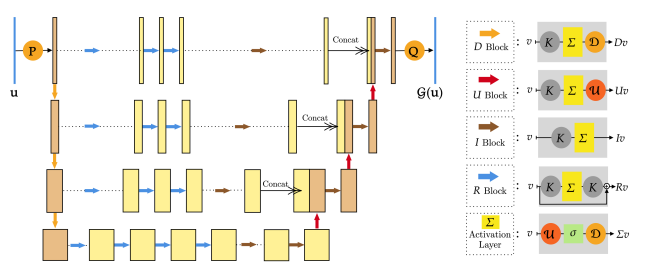
The model follows the Convolutional Neural Operator (CNO) architecture described in the 2023 CNO paper, adapted to complex-valued electromagnetic fields. The network operates on tensor-valued inputs defined on the grid and learns a resolution-agnostic operator in feature space.
- Input channels: real/imag parts of $\varepsilon_r$, incident field, and auxiliary features
- Encoder: lifts inputs to a higher-dimensional feature space
- CNO blocks: local projections + convolutional mixing + residual connections
- Decoder: projects features back to 2 channels (real and imaginary parts of $E_t$)
- Activation: Swish
- Optimizer: AdamW (learning rate $10^{-3}$, weight decay 0.001)
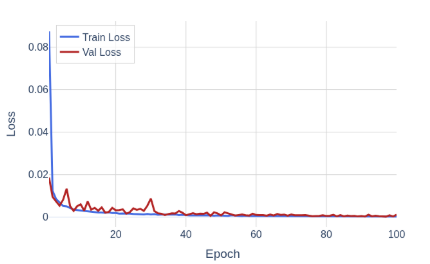
- Batch size: 80, epochs: 100, validation split: 20%
Loss and Error Metrics
Complex Mean Squared Error (MSE)
Let $z_i$ and $\hat{z}_i$ denote the ground-truth and predicted complex fields at grid point $i$. The complex MSE over a dataset of size $N$ is
$$ \text{MSE} = \frac{1}{N} \sum_{i=1}^{N} \left| \hat{z}_i - z_i \right|^2, $$
where $$ |z|^2 = (\Re(z))^2 + (\Im(z))^2. $$
Complex Relative Error
The complex relative error is
$$ \text{RelErr} = \frac{1}{N} \sum_{i=1}^{N} \frac{ \left| \hat{z}_i - z_i \right| }{ \left| z_i \right| }. $$
Training Loss vs Epoch
Training and validation curves for the complex MSE show stable convergence without severe overfitting.
Qualitative Results
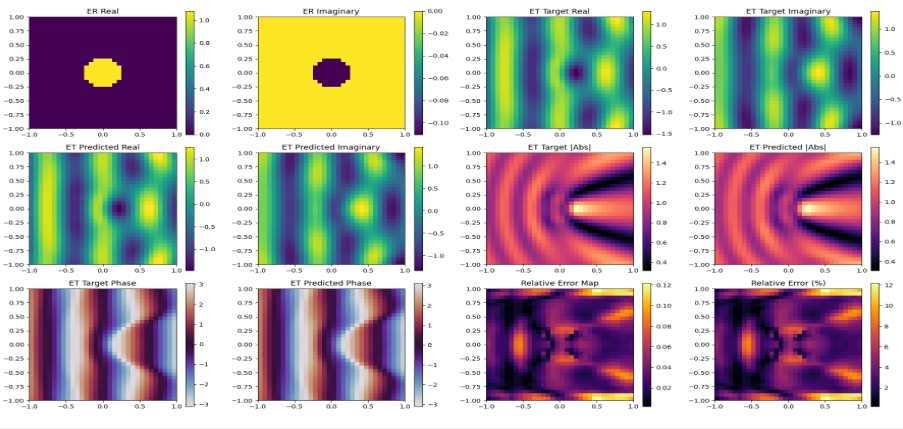
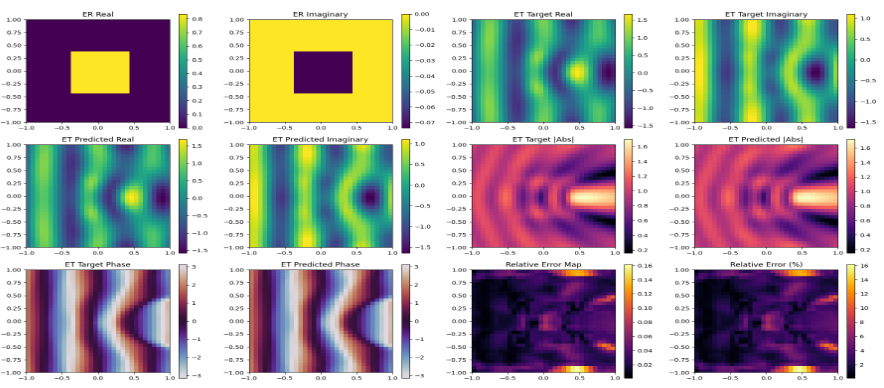
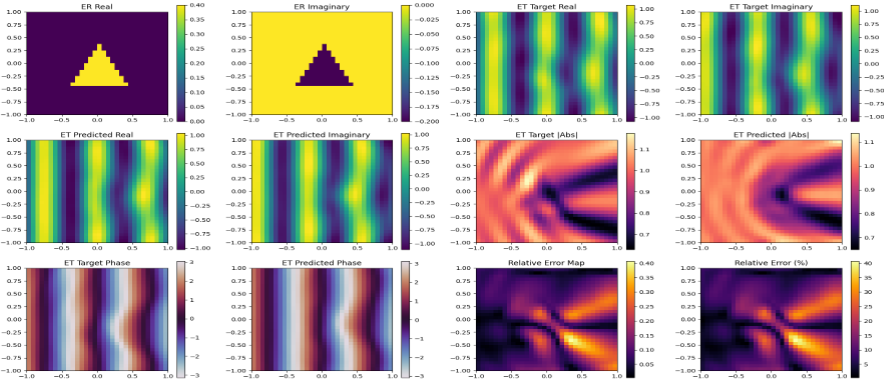
The figures below show visual comparisons between numerical solver output and CNO predictions for representative samples.
Training Samples
In-Distribution Validation (ID)
Out-of-Distribution (OOD) Test
Quantitative Performance
Performance is reported separately for in-distribution (ID) and out-of-distribution (OOD) configurations:
In-distribution (ID): typical complex relative error
$\text{RelErr}_{\text{ID}} \approx 2\% \text{–} 3\%$
Out-of-distribution (OOD): for unseen shapes and permittivity ranges
$\text{RelErr}_{\text{OOD}} \approx 9\% \text{–} 12\%$
Runtime Comparison
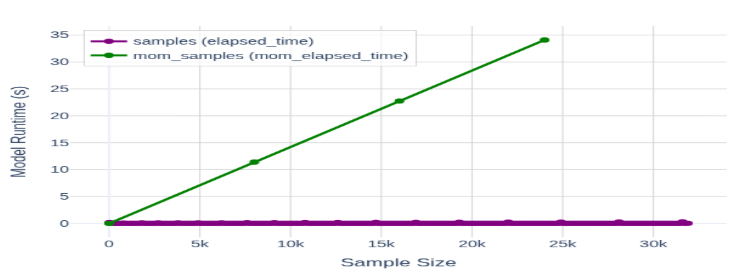
One of the main advantages of a neural-operator surrogate is its fast inference time compared to classical solvers.
- CNO inference time: $\approx 0.05$ seconds per sample (on a GPU setup)
- FDFD / MoM: typically seconds to minutes per sample for comparable resolution
Tools and Implementation
- Language: Python
- Core library: JAX
- Neural network library: FLAX / NNX
- Training: custom CNO implementation with AdamW optimization
Source Code
Full training and evaluation code is available at GitHub repository .
Project Report
This work is based on my B.Tech project report . “Microwave Imaging using Neural Operators” completed at IIITDM Kurnool, under the supervision of Dr. Yashwanth Kalepu .